Disclosure: This page contains affiliate links. If you book through them, we may earn a small commission at no extra cost to you — it helps keep this site running.
Short answer: give Luxor two days. Spend one on the East Bank at Karnak and Luxor Temple, and one on the West Bank at the Valley of the Kings and the Temple of Hatshepsut. A foreign adult should expect to pay about EGP 750 for the Valley of the Kings, with Tutankhamun’s tomb as a separate EGP 700 add-on, about EGP 600 for Karnak and about EGP 440 for Hatshepsut, indicatively, as of 7 October 2026. Start early; the heat is the main planning constraint.
Why Luxor deserves two days
Luxor sits on the Nile about 660 kilometres south of Cairo and holds a large share of Egypt’s pharaonic monuments. In ancient times it was Thebes, the capital of the New Kingdom, and the river divides the city in two: temples for the living on the East Bank, and tombs and mortuary temples for the dead on the West Bank. That geography is also your itinerary. A single long day can cover both banks, but the heat and the sheer scale of the sites make it exhausting; two days lets you do the monuments in the cool of the morning and rest in the afternoon.
How to get to Luxor
| From Cairo | Typical journey | Notes |
|---|---|---|
| Domestic flight | about 1 hour | The fastest option; Luxor has its own international and domestic airport |
| Overnight sleeper train | about 9–10 hours | Cheap and atmospheric, with a night’s accommodation in the fare, but long |
| Private car or tour | a full day | Possible but rarely sensible given the distance |
Most visitors fly. If you arrive by air, a pre-booked transfer to your hotel avoids negotiating with taxi drivers at the airport, and it can be arranged in advance.
Private Luxor airport (LXR) transfer — check today’s price
Ticket prices — indicative, checked 7 October 2026
| Site | Foreign adult | Foreign student | Notes |
|---|---|---|---|
| Valley of the Kings — general entry | EGP 750 | EGP 375 | Normally includes visits to three tombs from the open selection |
| Tutankhamun’s tomb (KV62) | EGP 700 extra | — | A separate ticket on top of general entry |
| Tombs of Ramesses V and VI | EGP 220 extra | — | A large, richly decorated tomb often recommended as an add-on |
| Tomb of Ay | EGP 200 extra | — | Located in the West Valley area |
| Tomb of Seti I | EGP 2,000 extra | — | The most expensive option; decorated to a very high standard |
| Karnak Temple | about EGP 600 | — | Reported by one cross-checked source; confirm on arrival |
| Temple of Hatshepsut | about EGP 440 | — | Mortuary temple at Deir el-Bahari |
| Luxor Museum | about EGP 400 | — | Reported figure; confirm before you plan around it |
Prices checked 7 October 2026. Entrance fees in Egypt are set by the Ministry of Tourism and Antiquities and change without much warning. The figures here come from published visitor-information pages cross-checked on that date, not from a booking we made ourselves — treat them as a guide and confirm the live price at the ticket window or on the booking page before you pay.
A worked example, so you can plan the money. A visitor who wants the Valley of the Kings with Tutankhamun’s tomb, plus Karnak and Hatshepsut, would pay roughly EGP 750 + 700 + 600 + 440 = EGP 2,490 in entrance fees, before transport and guides. Student rates halve the base ticket where they apply, up to the age limit, and require a valid student ID. Several large sites now take card payments only, so bring a bank card as well as cash.
Day one: the East Bank
Karnak Temple (morning)
Karnak is not a single temple but a vast complex built and added to over roughly two thousand years, and it is among the largest ancient religious sites in the world. The centrepiece is the Hypostyle Hall, a forest of 134 massive stone columns arranged in sixteen rows, the tallest rising more than twenty metres. Allow two to three hours. Arrive when the gates open, because the courtyards have almost no shade and the tour groups arrive within an hour.
Luxor Temple (late afternoon or evening)
Luxor Temple stands in the middle of the modern city and is at its best when lit at night. It is shorter than Karnak and takes about an hour. The restored avenue of sphinxes that once linked the two temples is also part of the story; check its current status and visiting hours locally.
East Bank budget view
| Time | Plan | Roughly how long |
|---|---|---|
| 07:00 | Karnak Temple | 2–3 hours |
| 11:00 | Back to the hotel, lunch, rest out of the midday heat | 3 hours |
| 16:30 | Luxor Temple | About 1 hour |
| 18:30 | Dinner on the Corniche by the river | 1–2 hours |
Day two: the West Bank
Sunrise balloon (optional)
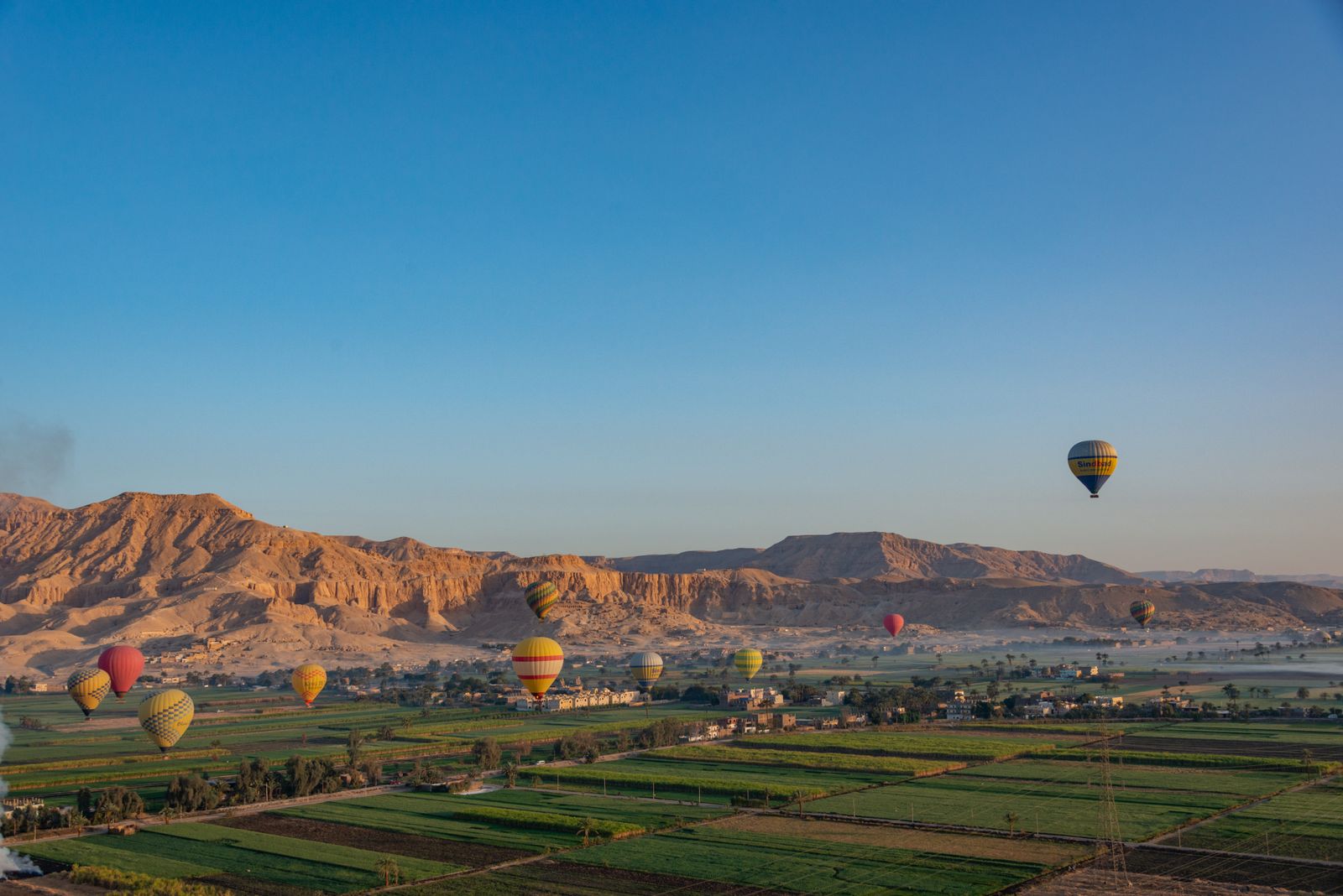
Dawn balloon flights drift over the West Bank, the Nile and the temples as the sun comes up. It is one of Luxor’s signature experiences and also one of the more expensive. Flights depend on weather and can be cancelled for wind, and the pickup is before dawn, so factor in the early start. If you plan to fly, schedule it on the West Bank day, because you are already on that side of the river.
Sunrise hot air balloon rides over Luxor — see today’s price
Valley of the Kings (morning)
The valley is a dry, hot canyon in the cliffs of the West Bank where New Kingdom pharaohs were buried in rock-cut tombs for about five centuries. More than sixty tombs have been found. The general ticket lets you enter a choice of three tombs from the day’s open list, and which ones are open rotates for conservation, so you do not choose in advance. Tutankhamun’s tomb is small, because the young king died unexpectedly, but it is the one where Howard Carter’s team found the intact burial in 1922. The larger tombs of the Ramesside kings, with long corridors of painted reliefs, are where most visitors feel the value of the ticket.
Temple of Hatshepsut (late morning)
Hatshepsut’s mortuary temple, in a bay in the cliffs at Deir el-Bahari, is a set of colonnaded terraces rising against the rock face. Hatshepsut ruled as a pharaoh in her own right in the fifteenth century BC, and the reliefs include scenes of a trading expedition to the land of Punt. It is open and sun-exposed, so go before the midday heat.
West Bank plan
| Time | Plan | Notes |
|---|---|---|
| 05:00 | Optional balloon flight | Weather permitting; pickup in the dark |
| 07:30 | Valley of the Kings | Three tombs on the general ticket, plus any add-on |
| 10:30 | Temple of Hatshepsut | About 1 hour |
| 12:00 | Lunch and rest | Take the afternoon off the monuments |
| 15:30 | Optional extras | The Luxor Museum, or sunset by the river |
Orientation — how the two banks connect
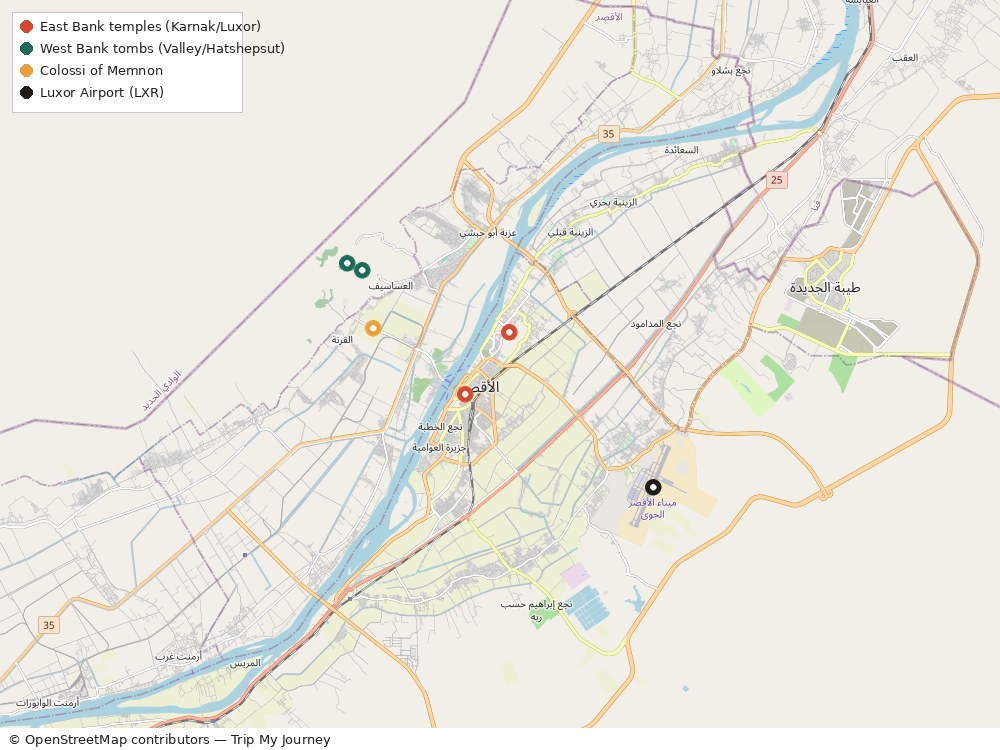
The East Bank is compact and walkable in parts, with the temples, the Corniche and most hotels close together. The West Bank is the reverse: the Valley of the Kings, the Temple of Hatshepsut and the other monuments are spread across dry hills and farmland, several kilometres apart, so you will want a car with a driver, a tour or a taxi arranged for the day. Crossing the river is done by passenger boat near the centre or by the road bridge to the south. Agree transport prices before you start, and decide whether the driver waits at each stop.
Where Luxor fits in a wider Egypt trip
Most itineraries start in Cairo for the pyramids and the Grand Egyptian Museum, then fly south to Luxor, and sometimes continue to Aswan or a Nile cruise. A week in Egypt can be: three nights in Cairo, with a possible day trip to Alexandria, two nights in Luxor, and the rest on the Red Sea or a cruise. If you have a short trip, choose between Alexandria and Luxor rather than trying both; they are in opposite directions and each deserves a full day or more.
Practical tips
- Season. The comfortable months run from October to April, with the peak between November and February. From May to September daytime temperatures are extreme and the plan above is only workable if you are at each site at opening time.
- Start early. Sites open early in the morning and close in the late afternoon; check current hours as they change seasonally.
- Carry water and sun protection. There is little shade at Karnak and none in the valley.
- Use a bank card. Several major sites are moving towards card-only ticketing.
- Hire a guide for the tombs. The inscriptions are easier to follow with one, and guides can be arranged through your hotel or a booking provider.
- Beware of unofficial offers. People who approach you outside the gates with “special” tickets or tours are best politely declined.
- Dress modestly at temples. It is not required at the ancient sites, but covered shoulders and sensible shoes work better in the sun and on uneven stone.
Booking a guided option
Independent visits work well in Luxor, but many travellers prefer a licensed guide for the Valley of the Kings and Karnak, with transport arranged between the banks. Tours bundle the driver, the guide and the logistics, and you pay the entrance fees either inside the tour price or separately, depending on the operator, so read the inclusions. Compare options on the live pages below.
Karnak Temple tickets and tours — check price on Trip.com
Valley of the Kings guided tour — check price on Trip.com
Frequently asked questions
Can I do Luxor in one day? You can see Karnak and the Valley of the Kings, but the pace is hard and the heat in summer is punishing. Two days is better.
Is Tutankhamun’s tomb worth the extra EGP 700? Opinions differ. The tomb is small and most of the treasure is in the Grand Egyptian Museum in Giza, so many visitors choose a larger Ramesside tomb instead. It depends on whether you want to stand in the place where the burial was found.
Where should I stay? The East Bank has most hotels and restaurants and is easier for getting around; the West Bank is quieter and rural. Choose by what you value, and note that early starts are easier from the West Bank on the valley day.
What else is there? Day trips to other temples such as Dendera and Abydos are possible by car. They are optional extras if you have a third day.
Will prices change? Often. The figures on this page were checked on 7 October 2026, and the ministry changes fees without much notice.
Check live prices and book
For the current price and dates for Luxor tours, balloon flights, transfers and tickets, check each operator’s own booking page. It is the final check before you commit, because the numbers above are a dated snapshot.
See live Luxor tour & ticket prices on Trip.com
Related guides: Best things to do in Luxor · Grand Egyptian Museum guide · Egypt and beyond East Asia.
Check current prices and book Luxor tours, tickets and day trips on Trip.com.Browse tours & tickets on Trip.com →