Disclosure: This page contains affiliate links. If you book through them, we may earn a small commission at no extra cost to you — it helps keep this site running.
Short answer: yes, Alexandria works as a long day trip from Cairo, but only if you accept that about five to six hours of the day are travel. The city is roughly 220 kilometres from the capital; the train and the private car both take around three hours each way, depending on traffic and service. Plan to see four things well — the Qaitbay Citadel, the Catacombs of Kom el-Shoqafa, the Bibliotheca Alexandrina and the seafront — rather than eight badly.
Is a day trip the right choice?
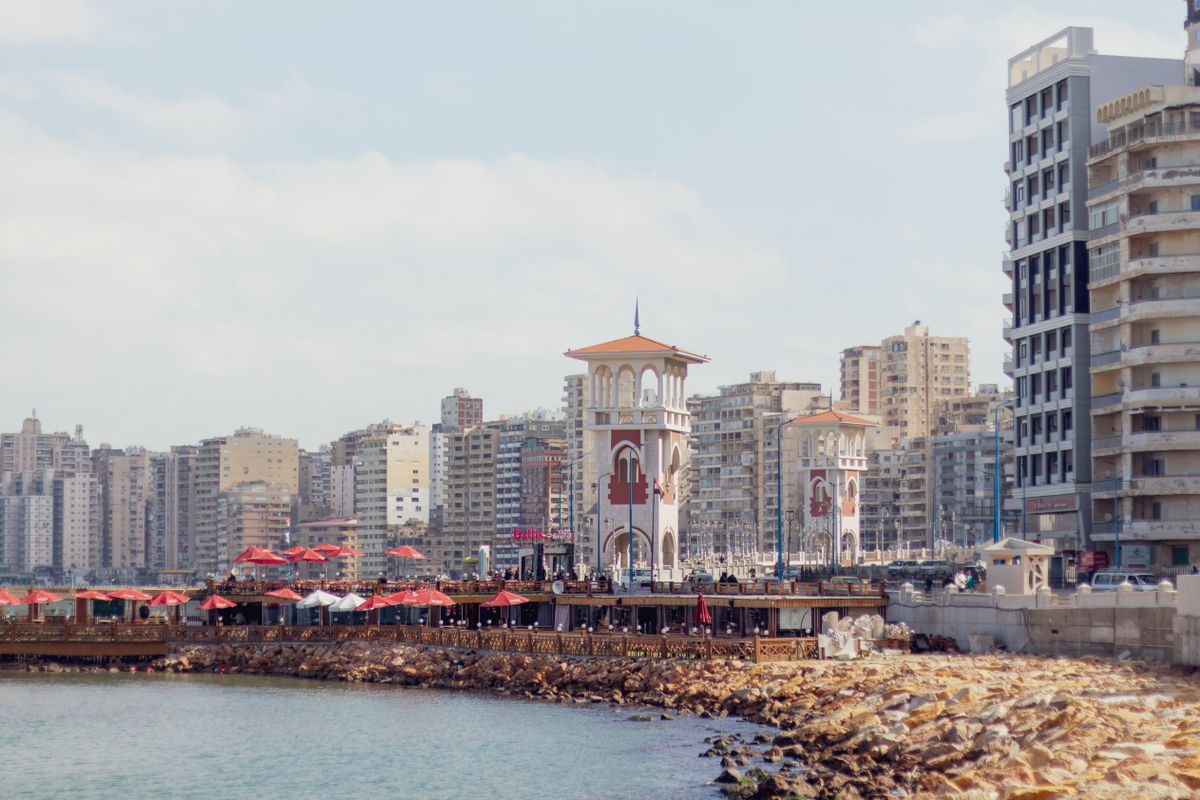
Alexandria is a different kind of Egyptian city. It was founded by Alexander the Great in 331 BC and became one of the ancient world’s great centres of learning and trade, but very little of that classical city survives above ground. What you find instead is a layered Mediterranean city: Greco-Roman remains, a fifteenth-century sea fort, a modern library, and a long seafront with a more relaxed pace than Cairo.
That shapes the decision. If you have only three or four days in Egypt and want the pyramids, the Grand Egyptian Museum and the old city of Cairo, Alexandria will cost you a full day you may prefer to spend elsewhere. If you have six days or more, or if you are specifically interested in Greco-Roman history, the Mediterranean or seafood, a day trip is a good change of scene. A stay of one night is better still, because it removes the two long days of travel and lets you see the seafront in the evening.
Getting from Cairo to Alexandria — the options compared
| Option | Journey time (typical) | Why choose it | Watch for |
|---|---|---|---|
| Fast train | about 2.5–3 hours | Predictable, comfortable, no road traffic, usually the best value | Book the faster services; seats on popular days sell out, so reserve ahead |
| Intercity coach | about 3–3.5 hours | Frequent departures from several Cairo terminals, cheap | Road traffic out of Cairo on the Desert Road can add time |
| Private car with driver | about 3 hours each way | Door to door, flexible stops, the driver waits at each sight | The most expensive, but practical for groups and families |
| Organised day tour | a full day, usually 12 hours or more | Everything bundled: transport, guide, entry coordination | Fixed schedule and group pace |
| Overnight stay | Leave and arrive at any time | Sunset on the corniche, evening meals, no rush | Adds a hotel night |
If you want one recommendation: take the train down in the morning, spend the day on foot and by short taxi rides in Alexandria, and take the train back in the evening. The train avoids the unpredictability of the road and leaves you free of a driver’s schedule. If you are travelling with several people or with luggage, or you simply do not want to organise anything, a private driver for the day is easier and is often competitive on price once split between travellers. You can check the current price for a private-car day trip here:
Private day trip to Alexandria from Cairo by car — check today’s price
The sights and what they cost — indicative prices, checked 7 October 2026
| Sight | Foreign adult (indicative) | What it is |
|---|---|---|
| Qaitbay Citadel | about EGP 200 | A fifteenth-century sea fort at the harbour mouth, built where the Pharos lighthouse once stood |
| Catacombs of Kom el-Shoqafa | about EGP 200 | Roman-era burial complex cut into the rock, with a mix of Egyptian and Greco-Roman decoration |
| Pompey’s Pillar | about EGP 150 | A tall granite column from the late third century, with the remains of the Serapeum around it |
| Catacombs plus Pompey’s Pillar (combined) | about EGP 280 | One combined ticket reported for the two sites together |
| Bibliotheca Alexandrina — main library | about EGP 150 | The modern library opened in 2002 as a successor to the ancient one |
| Bibliotheca Alexandrina — with museums | about EGP 300 | Adds the antiquities and manuscripts museums |
Treat these as indicative. Alexandria’s prices are published less consistently than Cairo’s, and sources for the library in particular disagree, with at least one older figure far lower than the ones above.
Prices checked 7 October 2026. Entrance fees in Egypt are set by the Ministry of Tourism and Antiquities and change without much warning. The figures here come from published visitor-information pages cross-checked on that date, not from a booking we made ourselves — treat them as a guide and confirm the live price at the ticket window or on the booking page before you pay.
The cost of the day is dominated by transport, not tickets, so a wrong guess of a few dozen pounds will not change your plan.An hour-by-hour itinerary that actually fits
| Time | Where | What happens |
|---|---|---|
| 07:30 | Cairo (Ramses Station or your hotel) | Leave on the morning train, or pick up your driver |
| 10:30 | Arrive in Alexandria | Take a taxi directly to the Qaitbay Citadel; the seafront drive is the first view of the city |
| 11:00 | Qaitbay Citadel | About 60–90 minutes: walk the walls and the terraces over the harbour |
| 12:30 | Seafront lunch | Seafood restaurants line the corniche; choose by what is on the day’s display rather than by the menu |
| 14:00 | Catacombs of Kom el-Shoqafa and Pompey’s Pillar | Short taxi hop; both sights fit into about two hours together |
| 16:30 | Bibliotheca Alexandrina | The library’s main reading hall is the draw; allow 60–90 minutes |
| 18:00 | Corniche walk | Light fades over the water; the best part of the evening |
| 19:30 | Train back to Cairo | Late arrival in Cairo; keep the last departure time in mind |
The itinerary is deliberately tight and has no room for a long museum stop. If you want the Greco-Roman Museum or the Roman amphitheatre at Kom el-Dikka, swap one of the afternoon sights, or stay overnight.
What to look for at each stop
Qaitbay Citadel
The fort was built in the late fifteenth century by the Mamluk sultan Qaitbay, on the spot where the ancient Pharos lighthouse had stood until earthquakes brought it down. Some of the lighthouse stones were reused in the walls. Inside, a courtyard, a small mosque and a keep give you a route up to terraces with views over the harbour. The best photographs face back along the seafront towards the city. The walls are exposed to wind and spray, so bring a layer in winter.
Catacombs of Kom el-Shoqafa
The name means “mound of shards”. The catacombs were cut into the rock in the first and second centuries AD and used for burial over several generations. The main tomb mixes Egyptian figures, such as gods in funerary poses, with Greek and Roman styling in the same carved panels, which is the point of the visit: it shows how the two traditions merged in Alexandria. You descend a spiral staircase and move through narrow rock-cut rooms, so the visit suits visitors who are comfortable with steps and low ceilings.
Pompey’s Pillar
The name is a mistake that stuck. The granite column, around 25 metres tall, was erected in 297 AD in honour of the Roman emperor Diocletian, and has nothing to do with Pompey. It stands in the former precinct of the Serapeum, a major temple of the Greco-Egyptian god Serapis, and the surrounding site has sphinx statues and the remains of underground galleries.
Bibliotheca Alexandrina
The modern library opened in 2002 as a tribute to the ancient library, which was one of the great research institutions of the classical world. The building is a large tilted disc with a granite wall carved with characters from many alphabets. The main reading room descends in terraces under a sloping roof. It is a working library as well as a visitor attraction, so keep voices low in the reading areas and check which parts of the complex your ticket includes.
If you decide to stay the night
A single night changes the trip. You can arrive by lunchtime, see the Citadel and the catacombs in the afternoon, eat on the seafront as the lights come on, and visit the library the next morning before the return journey. Hotels in the city range from simple guesthouses to large seafront properties, and prices are usually lower than comparable hotels in Cairo. The extra cost buys you the best hours of the city and removes the pressure of the last train. If your Egypt itinerary has a spare day, this is the better way to see Alexandria.
Where to eat and what to look for
Alexandria’s strength is seafood. The corniche and the streets behind it have restaurants where you choose fish from the display and have it grilled, fried or baked, usually priced by weight. Ask for the weighed price before it goes to the kitchen, and check the total against it. For a lighter lunch, local bakeries and street cafés serve Egyptian staples such as ful, falafel and koshari. Allow time for a coffee on the seafront; the city has a long cafe culture.
Practical tips
- Book your train in advance for the morning outbound and the evening return, especially on weekends and holidays.
- Use ride-hailing or agree taxi fares first. Distances between the sights are short but not walkable in the heat.
- Bring a bank card and some cash. Many sites accept card payments, but small purchases and tips need notes.
- Dress for sun and sea breeze. The harbour is cooler than Cairo in summer, but the midday sun is strong, and the fort is exposed.
- Check closing times before you go. Smaller sites close earlier than the large ones, and last entry is often an hour before.
- Keep your valuables close in train stations and on crowded corniche pavements.
When to go
The comfortable season runs from October to April. In winter the sea breeze can feel cool and the city occasionally has rain and heavy swell, which can close the harbour-side paths. Summer is humid, though the seafront still provides some relief compared with inland Cairo. Weekends are busy with Egyptian families, particularly on summer evenings, and the corniche can be crowded.
Frequently asked questions
Can I see the whole city in a day? No. The plan above is a selection. Choose the sights that match your interest and give each time.
Is the ancient lighthouse still there? No. The Pharos was destroyed by earthquakes, and its stones helped build the fort. Parts of it have been identified underwater near the Citadel.
Is it safe for a day trip? Visitors routinely make the trip. Take ordinary city precautions and confirm times and prices for each sight on the day.
Train or private car? The train for one or two travellers; a private car for families, groups or anyone who wants a single booking that handles everything.
Do I need a visa for Egypt? It depends on your nationality, so check the official requirements well before you travel.
Check prices and book
The figures here are a snapshot dated 7 October 2026, and transport availability changes daily. For current prices on day trips, private cars and Alexandria activities, check the operator’s own booking page — it shows live prices and dates and is the right final check before you commit.
See Alexandria & Cairo day trips on Trip.com
Related guides: Best things to do in Alexandria · Best things to do in Cairo · Egypt and beyond East Asia.
Check current prices and book Alexandria tours, tickets and day trips on Trip.com.Browse tours & tickets on Trip.com →